
Table of Contents
ToggleHow to Use an AED (Automated External Defibrillator) – Step-by-Step Guide
Introduction to AEDs
An Automated External Defibrillator (AED) is one of the most critical tools in emergency first aid, designed to save lives during sudden cardiac arrest (SCA). Every year, millions of people worldwide experience sudden cardiac arrest, and without immediate intervention, the chances of survival drop drastically—by about 10% every minute without CPR or defibrillation. The AED bridges this life-or-death gap by delivering an electric shock that can restore a normal heart rhythm.
AEDs aren’t just for trained medical professionals; they are intentionally designed to be user-friendly so that anyone—even without prior medical training—can operate one during an emergency. Airports, shopping malls, schools, gyms, and even some residential complexes now keep AEDs on-site, ready for use when every second counts.
In this guide, we’ll break down exactly how to use an AED, step by step, so you’ll feel confident and prepared if you ever face a life-threatening emergency.
What is an AED?
An AED is a portable, battery-powered device that analyzes the heart’s electrical activity and, if necessary, delivers a controlled electric shock to restore a normal rhythm. Unlike the defibrillators seen in hospitals that require training, AEDs are designed with clear visual instructions and voice prompts to guide the user through every step.
Most AEDs contain:
-
Electrode pads: Adhesive pads that detect the heart rhythm and deliver the shock.
-
Control unit: The main body of the device that interprets the heart’s rhythm and decides if a shock is needed.
-
Battery pack: Provides the energy to power the unit and deliver the shock.
-
Visual and audio instructions: Clear prompts that tell the rescuer exactly what to do.
AEDs are incredibly accurate—they will not deliver a shock unless the device detects a shockable rhythm like ventricular fibrillation (VF) or pulseless ventricular tachycardia (VT). This built-in safeguard ensures that you cannot accidentally harm the victim by misusing the device.
Why AEDs are Life-Saving Devices
The heart’s electrical system controls the rate and rhythm of the heartbeat. In sudden cardiac arrest, this system malfunctions, often causing chaotic, ineffective rhythms that prevent the heart from pumping blood. This is where defibrillation—the delivery of an electric shock—comes in.
Research shows that using an AED within the first three minutes of cardiac arrest can increase the victim’s survival rate to over 70%. That’s why public access to AEDs is critical. In many countries, “public access defibrillation” programs ensure AEDs are placed in high-traffic areas where emergencies are likely to occur.
AEDs also reduce the need for guesswork. They automatically analyze the heart rhythm and decide whether a shock is necessary, guiding the rescuer with easy-to-understand voice prompts. This means even if you’ve never touched an AED before, you can still use it effectively in a crisis.
Understanding How an AED Works
An AED works by delivering an electrical pulse to the heart to stop abnormal rhythms and allow the heart’s natural pacemaker to regain control. When you attach the electrode pads, the AED quickly measures the victim’s heart rhythm. If it detects VF or pulseless VT, it charges itself and instructs you to press the shock button.
The shock temporarily stops the heart’s electrical activity, which might sound scary, but this pause is what gives the heart a chance to restart with a normal rhythm. If no shockable rhythm is detected, the AED will advise you to continue CPR until emergency medical services (EMS) arrive.
The Science Behind Defibrillation
To understand defibrillation, think of the heart as a drum keeping the beat of life. In cardiac arrest, that beat becomes erratic or stops entirely. The AED acts like a conductor, delivering an electric “reset” so the heart can resume its steady rhythm.
Electrical impulses in the heart are controlled by specialized cells that tell the chambers when to contract. In VF or VT, these signals are chaotic, and the heart muscle quivers instead of pumping blood. The AED’s shock depolarizes the heart cells simultaneously, halting the chaos and giving the natural pacemaker cells a fresh start.
When an AED Should Be Used
An AED should be used immediately when someone:
-
Collapses suddenly
-
Is unresponsive
-
Has no normal breathing or only gasping
-
Has no detectable pulse
Remember: Call emergency services first, then start CPR and use an AED as soon as possible. The combination of CPR and defibrillation is the best way to maximize survival chances.
Preparing to Use an AED
Before you grab an AED, you must ensure the scene is safe for both you and the victim. If there are hazards like live wires, fire, or water, address them before beginning. Then, quickly check the victim for responsiveness by tapping their shoulders and shouting, “Are you okay?”
If there’s no response, call emergency services (or direct someone else to do it) and immediately send someone to retrieve an AED while you begin CPR. Once the AED arrives, you’ll transition from manual chest compressions to using the device according to its prompts.
Step-by-Step Guide to Using an AED
Turning On the AED
Once you have the AED in your hands, the first thing you must do is turn it on. Most AEDs have a prominent power button or a lid that, when opened, automatically powers the device. This immediate activation is crucial because the AED will start giving voice prompts right away, guiding you step-by-step.
From here on, think of the AED as your coach—it will not only instruct you on what to do next but also monitor the victim’s heart rhythm to decide if a shock is needed. The sooner you power it on, the sooner life-saving analysis and treatment can begin.
It’s important to note that you don’t need to memorize complicated medical procedures to operate an AED. Every action is designed to be intuitive, so you can focus on following directions rather than second-guessing yourself. This is especially important in emergencies, when adrenaline is high, and clear thinking is hard.
Attaching the AED Pads Correctly
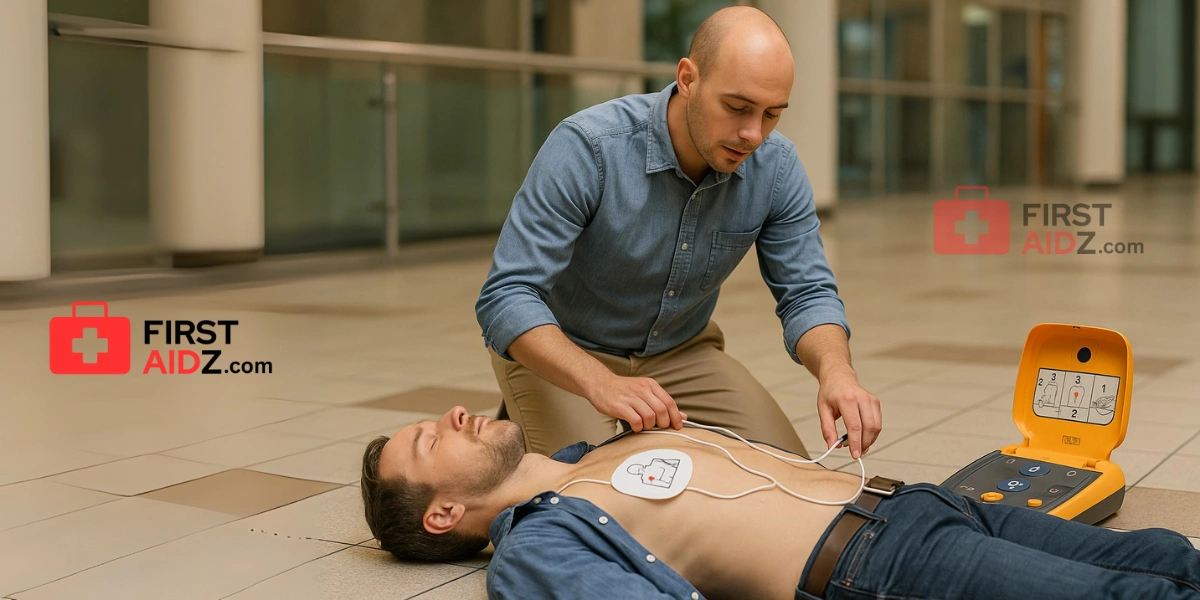
AED pads are pre-connected or come with clear diagrams showing where to place them:
-
One pad goes on the upper right chest, just below the collarbone.
-
The other goes on the lower left side of the chest, a few inches below the armpit.
These positions are not random—they allow the electrical current to travel through the heart in the most effective path.
Before placing the pads:
-
Expose the chest completely.
-
Dry the skin if it’s wet.
-
Shave excessive hair quickly if it prevents pad contact (most AED kits contain a razor).
Good contact between the pad and the skin is essential. Poor adhesion can interfere with the shock and reduce the chance of restoring a normal rhythm.
Following AED Voice Prompts
After the pads are attached, the AED will analyze the heart rhythm automatically. During this stage, do not touch the victim—movement can cause inaccurate readings.
If the AED detects a shockable rhythm, it will say something like:
“Shock advised. Charging. Stand clear.”
You must ensure nobody is touching the victim at this point. This is both for safety and to ensure the electrical current travels through the patient only.
If no shock is advised, the AED will instruct you to resume CPR immediately. Follow these prompts without delay—every second counts in cardiac arrest.
Delivering the Shock Safely
If a shock is advised, the AED will tell you when it’s ready and prompt you to press the shock button. Some newer AEDs deliver the shock automatically, but most require you to press the button yourself.
Before pressing the button:
-
Loudly say, “Stand clear!”
-
Visually confirm that nobody is touching the victim.
Once you press the button, the AED delivers the shock in less than a second. Afterward, it will immediately guide you to resume CPR for about two minutes before reanalyzing the rhythm.
This cycle of shock-CPR-analysis continues until EMS arrives or the victim shows signs of recovery, such as breathing normally or regaining consciousness.
After the AED Delivers a Shock
Continuing CPR if Necessary
A common misconception is that after a shock, the victim will instantly wake up like in a movie. In reality, the shock’s purpose is to restore a viable rhythm, but the heart still needs help circulating oxygen until it stabilizes.
That’s why, as soon as the AED tells you, you must resume chest compressions immediately. Continue with cycles of 30 compressions and 2 breaths (if trained) or continuous compressions if you’re untrained, until the AED advises otherwise.
Never remove the AED pads after the first shock—the device may need to deliver additional shocks. Keeping them attached ensures rapid reanalysis without delays.
Monitoring the Victim Until Help Arrives
Even if the victim regains consciousness, do not turn off the AED. Leave it running and pads in place while monitoring their breathing and pulse.
Continue to follow the AED prompts—it may still advise another shock if the heart slips back into a dangerous rhythm. EMS personnel will take over upon arrival, but your quick action may have already made the difference between life and death.
AED Safety Precautions
Avoiding Water and Metal Contact
When using an AED, one of the most important safety measures is to avoid water and conductive surfaces. Electricity follows the path of least resistance, so if the victim is lying in a puddle, on wet grass, or on a metal floor, the shock could be diverted—or worse, harm the rescuer or bystanders.
Steps to ensure safety:
-
Move the victim to a dry, safe location before attaching pads.
-
Quickly wipe the chest dry if it’s wet from sweat, rain, or pool water.
-
Avoid placing the victim directly on metal surfaces if possible. If unavoidable, ensure no one is touching the surface during the shock.
Water and metal are not just environmental hazards—they can make the difference between a successful shock and a dangerous mishap. Taking a few seconds to secure the environment can save lives and prevent injury.
Handling Hairy, Sweaty, or Wet Chests
A thick layer of chest hair can prevent the AED pads from sticking properly. If the pads don’t make full contact with the skin, the electrical shock might not pass through effectively. Most AED kits come with a small razor for this reason.
If chest hair is an issue:
-
Peel one pad off quickly to pull hair out in that area.
-
Shave the area where the pad will stick.
-
Apply the pad firmly.
For sweaty or wet skin, towel-dry the chest quickly before attaching pads. These extra few seconds can dramatically improve the AED’s effectiveness.
Special Situations When Using an AED
AED Use on Children and Infants
AEDs can be used on children and infants, but pediatric pads are recommended for those under 8 years old or weighing less than 55 pounds (25 kg). These pads deliver a smaller shock appropriate for smaller hearts.
If pediatric pads aren’t available, use adult pads, but ensure they don’t touch each other—one pad should be placed in the center of the chest and the other in the middle of the back.
Children can also experience cardiac arrest from drowning, choking, or congenital heart conditions, making AED access just as critical in pediatric emergencies as in adults.
AED Use on Pregnant Women
AEDs are safe for use on pregnant women. The priority in cardiac arrest is to save the mother’s life—restoring her heartbeat also benefits the unborn baby.
The process is the same as with other adults:
-
Call EMS immediately.
-
Apply AED pads in the standard positions.
-
Follow the prompts without hesitation.
Studies have shown that defibrillation does not harm the fetus when performed correctly, and delays could lead to tragic outcomes for both mother and child.
AED Use in Public Places vs. Homes
Public spaces like airports, gyms, and malls often have AEDs mounted on walls in visible cases. These devices are usually semi-automatic AEDs that require you to press the shock button when instructed.
At home, AEDs are becoming more common for people with high heart attack risk. These models are often fully automatic, delivering the shock without pressing a button once a shockable rhythm is detected.
Regardless of location, the key is fast action—the sooner the AED is in use, the greater the survival chance.
Maintenance and Storage of AEDs
Battery Checks and Pad Replacement
AEDs rely on charged batteries and adhesive electrode pads. Batteries typically last 2–5 years, and pads have an expiration date due to the gel drying out.
Routine checks should include:
-
Inspecting battery status indicators.
-
Replacing pads before expiration.
-
Running the device’s self-test (many AEDs do this automatically).
Keeping the AED in top condition means it will work instantly when needed—there’s no room for equipment failure during a real emergency.
Proper Storage Locations
AEDs should be stored in a visible, accessible location—never locked away in a cabinet where only one person has the key. Common storage locations include:
-
Near entrances/exits in public buildings.
-
In gyms or near fitness areas.
-
In office common areas.
AED cabinets often have alarms or lights to draw attention when opened, ensuring help arrives quickly.
Common Myths About AEDs
Myths vs. Facts
Even though AEDs are life-saving devices, there are still a lot of myths that can make people hesitate in emergencies. Let’s clear up some of the most common ones:
-
Myth: “Only trained medical professionals can use an AED.”
Fact: AEDs are designed for the public. They give clear voice prompts, and anyone can use them without prior training. -
Myth: “Using an AED on someone with a heartbeat will hurt them.”
Fact: AEDs analyze heart rhythms before delivering a shock. If a normal rhythm is detected, no shock will be given. -
Myth: “AEDs can restart a completely stopped heart.”
Fact: AEDs treat certain abnormal rhythms like VF and VT, not asystole (flatline). CPR is still essential if no shock is advised. -
Myth: “AED shocks are dangerous to bystanders.”
Fact: As long as no one is touching the patient during the shock, there’s no risk.
Dispelling these myths is crucial for encouraging more people to act quickly in emergencies without fear.
Importance of AED Training
Benefits of Learning AED Use
While AEDs are simple to operate, formal training can boost confidence and efficiency. Training helps you:
-
React faster under pressure.
-
Perform high-quality CPR in combination with AED use.
-
Handle special circumstances (children, wet environments, crowded spaces).
Training also teaches proper pad placement, safety checks, and what to do after defibrillation—skills that can make a difference in life-or-death situations.
Where to Get Certified
Organizations like the American Heart Association (AHA), Red Cross, and local EMS providers offer AED and CPR certification courses. These often combine online learning with in-person practice sessions using real AED units.
Many workplaces and schools now provide this training for staff and students. If you complete a course, you’ll receive a certification card that typically lasts two years before renewal is required.
Legal and Ethical Considerations
Good Samaritan Laws
In many countries, Good Samaritan Laws protect people who assist during emergencies from legal liability, provided they act in good faith and within their level of training. This means you shouldn’t fear legal consequences for trying to save a life with an AED.
Ethical Duty to Help
While the law may not always require bystanders to act, there’s an ethical argument that helping when you can is a moral responsibility. Cardiac arrest is often sudden and unexpected—your willingness to step in could give someone a second chance at life.
Conclusion
An Automated External Defibrillator is one of the simplest yet most powerful tools available to save someone from sudden cardiac arrest. With clear voice prompts, built-in safety measures, and straightforward operation, anyone can use an AED—even without prior training.
The key to saving a life is speed. Every minute without defibrillation reduces survival chances by about 10%. By learning how to use an AED and acting quickly, you could be the link in the chain of survival that makes all the difference.
FAQs
1. Can I hurt someone by using an AED if they don’t need it?
No. AEDs only deliver a shock if a shockable rhythm is detected.
2. How long should I perform CPR after using an AED?
Continue CPR until the AED instructs you to stop, or until emergency personnel arrive.
3. Can AEDs be used on children?
Yes, with pediatric pads if available. If not, adult pads can be used with adjusted placement.
4. What if the victim has a pacemaker?
Place AED pads at least one inch away from the device to avoid interference.
5. Are AEDs expensive?
Prices vary, but many organizations receive funding or donations to install them in public spaces.
DISCLAIMER:- This article is for educational purposes only and is not a substitute for professional medical training. Always follow AED instructions and seek emergency medical help immediately.
1 thought on “How to Use an AED (Automated External Defibrillator)”
Comments are closed.